We live in a culture that celebrates speed—faster progress, quicker results, and constant improvement. From a young age, many of us are taught that moving forward means doing more, achieving more, and planning further ahead. Slowing down, on the other hand, is often associated with falling behind or being unproductive. Slow Art emerges as a gentle counter-practice to this mindset, inviting us to pause, reconnect, and rediscover meaning through mindful creative expression.
Yet beneath this fast-moving surface, many people are tired.
Not just physically tired, but emotionally and mentally exhausted—overstimulated, overwhelmed, and disconnected from their inner world. We carry unprocessed emotions, unspoken grief, unresolved experiences, and quiet longings that rarely get space to be felt.
This is where a slower, more intentional creative practice enters—not as an escape from reality, but as a way of returning to ourselves.
What Is Slow Art?
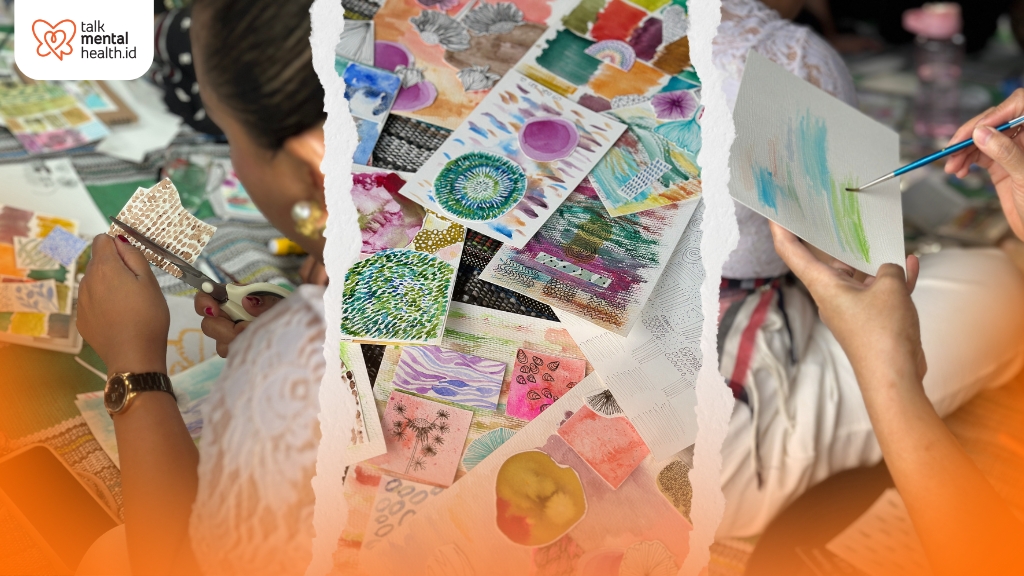
Slow art is a mindful and intentional approach to creative expression that prioritizes presence over performance. It invites us to slow down and engage in simple artistic activities—such as drawing, painting, coloring, mark-making, or journaling—without focusing on the final result.
This approach is closely linked to the Slow Art movement, which emerged as a response to what researchers describe as an image-saturated age—a time when images are consumed quickly, often without deep attention. Educational research and cultural analysis published by JSTOR highlight how slowing our engagement with art helps counter rapid visual consumption and supports deeper observation and reflection.
According to the framework discussed in “Slow Art: Analyzing Art in an Image-Saturated Age” (JSTOR), taking time with visual and creative processes allows for:
- Deeper observation and emotional engagement
- Reduced cognitive overload from rapid image consumption
- A more reflective, personal relationship with visual experience
In this practice:
- There is no pressure to be “good” at art
- There is no expectation to create something for others
- There is no comparison or aesthetic standard
Rather than producing an artwork to be viewed, shared, or validated, attention is redirected inward. The focus is placed on:
- The movement of the hands
- The rhythm of the breath
- Bodily sensations
- Emotions that gently surface
By intentionally slowing the act of making and observing, this form of mindful art counters habits shaped by fast-paced visual culture. It encourages prolonged attention—staying with a single line, color, or texture long enough for awareness and meaning to emerge naturally, rather than instantly.
This approach is not about producing art.
It is about being with yourself through art.
Because of its emphasis on slowness and embodiment, this creative method is widely used in mindfulness-based, trauma-informed, and mental health settings to support emotional awareness and nervous system regulation.
Slow Art and the Nervous System
From a mental health perspective, this practice offers something deeply important: a sense of safety.
When we are constantly rushed, evaluated, or pressured, our nervous system stays in a state of alert. Over time, this can lead to chronic stress, anxiety, emotional numbness, or burnout. The body remains tense even when the mind wants to rest.
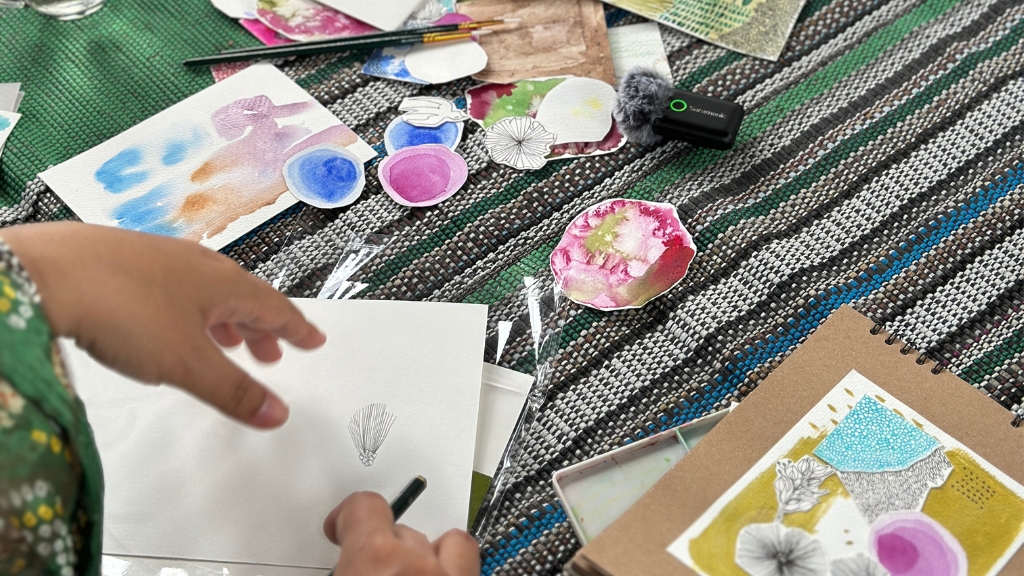
Slow, repetitive, and gentle creative movements—such as drawing simple patterns or painting without a goal—send signals of safety to the nervous system. The body begins to soften. The breath deepens. Thoughts slow down.
In this state, reflection becomes possible—not forced, but natural.
This process does not demand insight.
It allows insight to emerge.
Why Slow Art Matters for Mental Health
Many people struggle to articulate what they feel. Words can feel insufficient, overwhelming, or unsafe—especially when emotions are complex or long-held.
Slow art creates a non-verbal pathway to emotional processing.
Through this practice, people often experience:
- Reduced stress and mental clutter
- Greater emotional awareness without overwhelm
- A sense of grounding and embodied presence
- Gentle access to memories, insights, or feelings that have been avoided
Importantly, slow art does not require people to “fix” themselves.
It does not rush healing.
Instead, it honors the truth that healing often begins with listening.
Slow Art Is for Everyone (Not Just Artists)
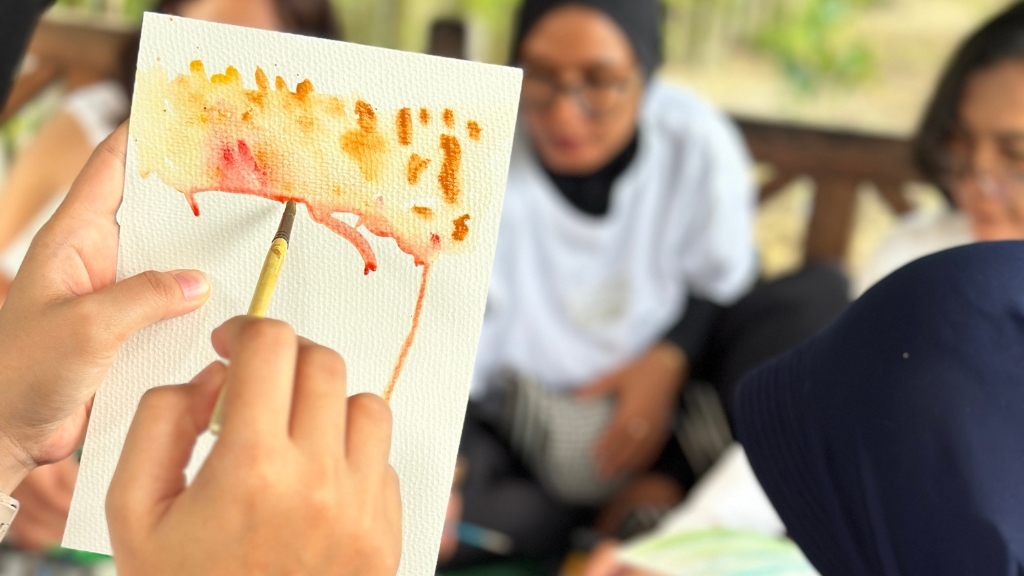
One of the most common fears people express before joining a slow art session is:
“I’m not creative.”
“I can’t draw.”
“I’m not an artist.”
Slow art was never meant for artists alone.
You do not need:
- Artistic talent
- Prior experience
- Confidence in creativity
Slow art is accessible because it values process over outcome. Simple lines, shapes, colors, and textures are enough. What matters is not what appears on the paper, but what happens within you as you create.
This makes slow art especially inclusive—for beginners, for people returning to creativity after a long time, and for those who feel disconnected from themselves.
Slow Art as a Reflective Practice
Beyond relaxation, slow art can also become a powerful reflective tool—especially during transitions such as the end of a year or the beginning of a new one.
When we move too quickly into the future, we often skip reflection. We carry unfinished emotional threads from the past year into the next, unconsciously repeating patterns we never had time to examine.
Slow art creates space to:
- Reflect on experiences without re-living them intensely
- Notice patterns, lessons, and emotional residue
- Integrate what has been learned before moving forward
Reflection does not have to be heavy.
It can be gentle, visual, and compassionate.
Slow Art Session: Preparing for 2026, Slowly and Intentionally
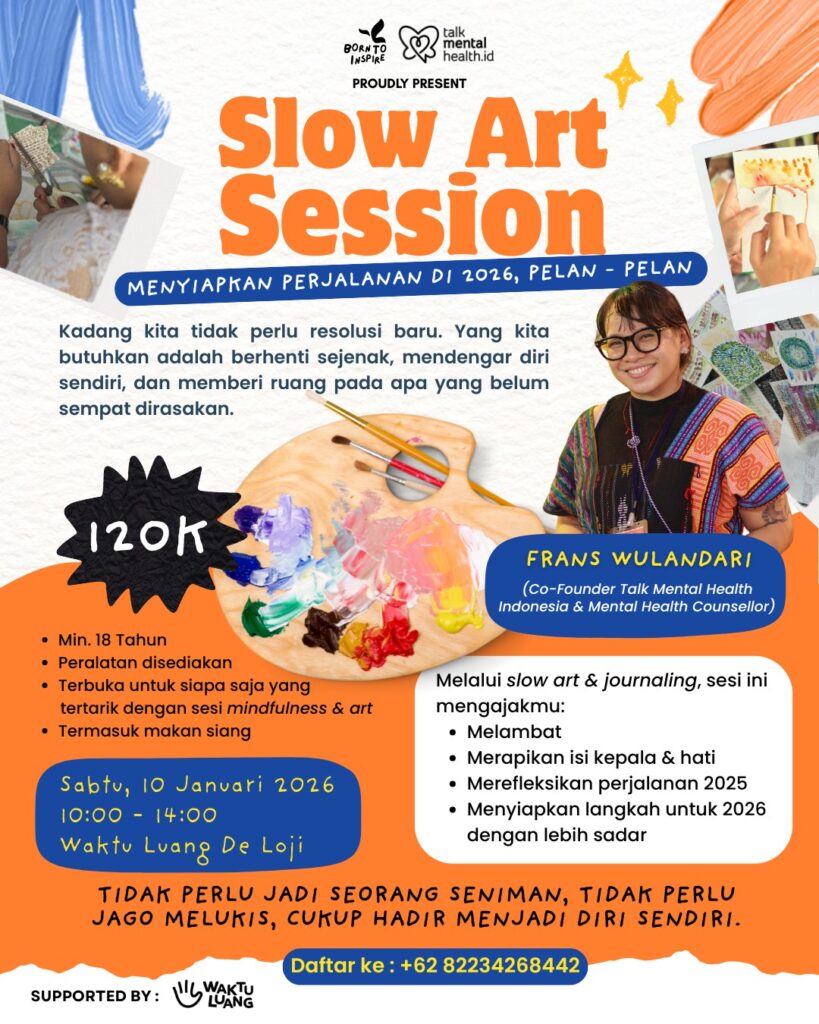
As part of Talk Mental Health Indonesia’s ongoing work to make mental health support accessible beyond clinical settings, we are hosting a Slow Art Session designed as a reflective pause between years.
Rather than focusing on resolutions or productivity goals, this session invites participants to slow down and reconnect—with their bodies, emotions, and inner direction.
Through guided slow art and journaling, participants will be supported to:
- Settle their nervous system
- Reflect on their journey through 2025
- Acknowledge what they are carrying emotionally
- Prepare for 2026 with clarity and intention
This session is not about pushing forward.
It is about arriving.
What You Will Experience
During the session, participants will be gently guided through:
- Slow, mindful art-making using simple materials
- Reflective journaling prompts that support emotional clarity
- Moments of pause to notice thoughts, feelings, and sensations
- A supportive and non-judgmental group environment
The process is designed to be safe, inclusive, and pressure-free. You are welcome exactly as you are.
Session Details
📅 Saturday, 10 January 2026
⏰ 10:00 – 14:00 (WIB)
📍 Waktu Luang De Loji
💰 IDR 120,000 (all art materials and lunch included)
👤 Minimum age: 18+
🎨 Open to all levels — no art experience required
Facilitated by Frans Wulandari, Co-Founder of Talk Mental Health Indonesia and Mental Health Counsellor.
You don’t need to be an artist.
You don’t need to be good at drawing.
You only need to show up as yourself.
📲 Registration:
WhatsApp +62 822 3426 8442
A Gentle Invitation
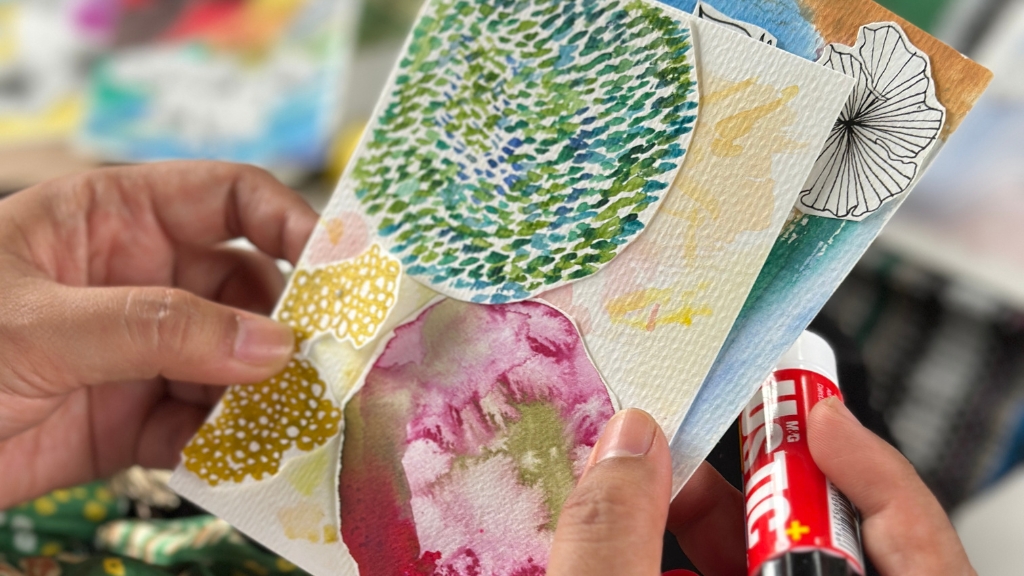
Sometimes, the most meaningful way to prepare for what comes next is not to rush forward—but to pause, feel, and listen.
Slow art is an invitation to do just that.
If you feel called to experience this practice in a shared, guided space, we warmly invite you to join our upcoming Slow Art Session—a reflective gathering that combines slow art, journaling, and mindful presence to help you gently close one chapter and step into the next.
Learn more and register via Instagram:
https://www.instagram.com/p/DS4oCmGE1Ve/?hl=en
For those who prefer to begin privately, at your own pace, we also invite you to download our free Slow Art & Reflection Zine—a gentle companion designed to help you pause, reflect, and reconnect through simple creative prompts.
Download our free zine here:
https://talkmentalhealthid.org/freebies/
Whether you choose to join us in person or start quietly on your own, we hope slow art becomes a doorway for you—to move into 2026 slowly, consciously, and with care.